skip to main |
skip to sidebar
 Players in Warhammer Online: Age Of Reckoning demonstrate distances in MMORPGs.
During Week 7 I borrowed E. Hall's 'The Silent Language' from the University library. I completed reading the book over the course of the week, and the source analysis report I wrote as a result can be found here."E. Hall's 'The Silent Language’ is an interesting source describing the myriad aspects of culture. While the book is probably required reading for anthropologists, I at first struggled to find meaning within it as relating to games design. Nonetheless riveting, it was only as I approached chapter ten, ‘Space Speaks’, which discusses from a Western point of view how distance affects communication. Within a three-dimensional space such as our level, this is integral."
 Dragon Age: Origins [Bioware, 2010]'s Alistair and Morrigan.
During Week 3 I borrowed C. Crawford's 'Chris Crawford On Interactive Storytelling' from the University library. I completed reading the book over the course of the week, and the source analysis report I wrote as a result can be found here."C. Crawford’s 'Chris Crawford On Interactive Storytelling’ is an intriguing book. On the one hand, it provides deep and detailed information regarding any way that plot and characters can be used in videogames, but on the other hand, is presented in such a confrontational and condescending way it’s hard to take the man seriously. This stems from the fact that while Crawford practically invented his field, other writers were published dealing with it prior to him, and there seems a kind of resentment present. Struggling through this, however, I found the book to be an excellent source for our project, as it presents further development in the ‘Personality Modelling’ I’ve been working on. While the entire book is useful from a narrative perspective, we are only concerned with Chapter 11, which deals with character-driven storytelling and believable NPCs."
 Street Fighter II [Capcom, 1991]'s Chun Li battles Blanka on the game's US Box Art.
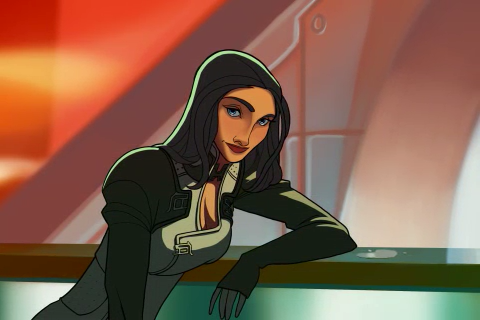 Mass Effect 2 [Bioware, 2010]'s Miranda Lawson, one of my example characters.
I found this book especially useful, as I had not previously considered visual and auditory design of characters, only the personality traits they exhibited. This will make my forthcoming Character Study on Dragon Age [Bioware, 2009]'s Loghain Mac Tir deeper and more interesting.


