During Week 2 I continued to gather questionnaires, as well as writing a Source Analysis of M. Krawczyk & J. Novak's 'Game Story & Character Development'. I also wrote a Character Study of Dragon Age's Loghain Mac Tir, and worked on many technical elements of the project, such as the Design Document and our possible tests.
Saturday, February 20

Week II - Character Study
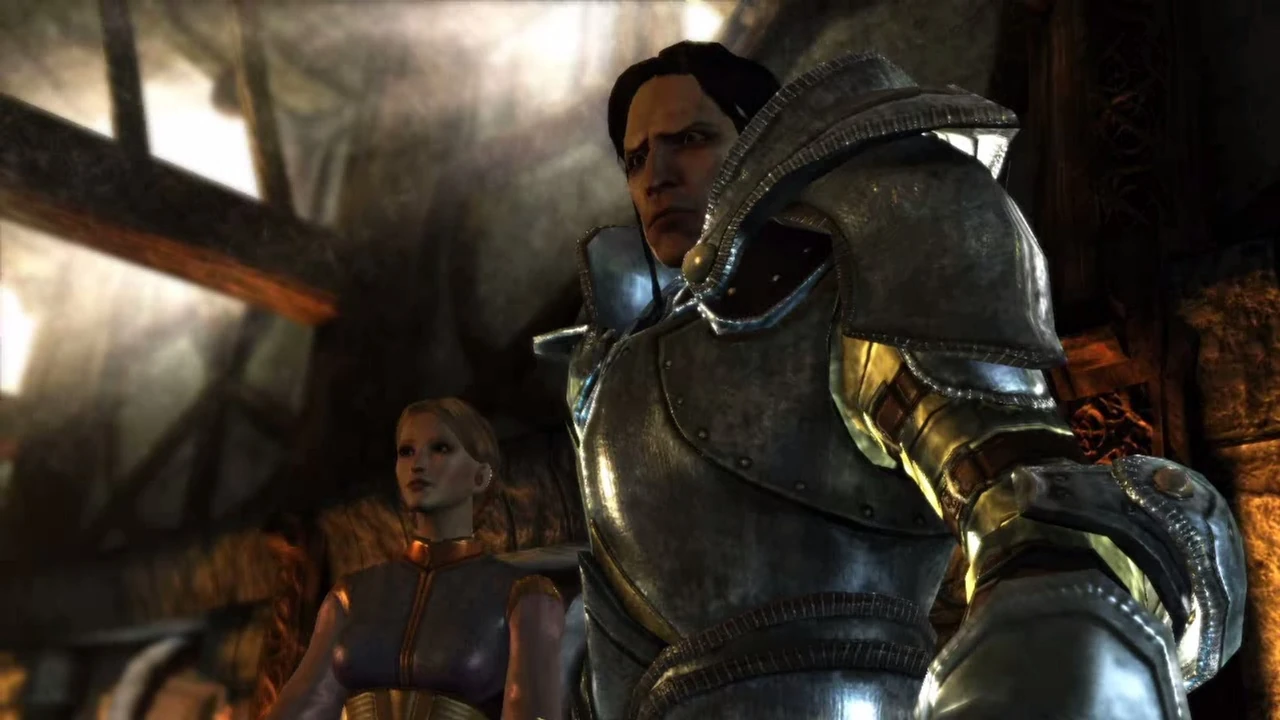 Dragon Age: Origins [Bioware, 2009]'s Loghain Mac Tir, and daughter Anora.
During Week 2 I wrote a character study of the Dragon Age character Loghain Mac Tir, reasoning that the game was still in my memory and I'd found the character incredibly compelling. The character study I wrote as a result can be found here.
"Bioware’s games are famed for their realistically-flawed and motivated characters. Their 2009 effort, Dragon Age: Origins is no different in this regard, and indeed is considered to have better characterisation than any of their other projects. The game pits the world-saving heroes of the Grey Wardens against a demonic horde set to overrun the country of Ferelden. Standing between the Grey Wardens and the unity required to stand against this Blight is general Loghain Mac Tir, Ferelden’s greatest hero and most valuable treasure, a man who truly represents the human ideal of hard work and dedication. A decisive, prideful and xenophobic man, Loghain’s defining character feature is that his ends always justify his means."
Thursday, February 18
Week II - Possible Test Frameworks
POSSIBLE TEST 1 - "THE MERCY TEST"
OVERVIEW:
Player and NPC (Villain) are seperated by an unbreakable glass wall at all times. As the player pursues the Villain the Villain releases AI enemies to harrass and defeat the player. Upon reaching the final room, however, the level diverges. The villain finds himself in a dead-end, and buttons in front of the player determine his fate. His reactions are as follows (numbers represent test configures):
1. Repentant - The Villain begs for the player's mercy and surrenders.
2. Arrogant - The Villain taunts the player.
The player then has the choice between the two buttons- Kill or Save. Pressing the 'Kill' button causes the Villain to be killed by the room. A set time after the villain dies, the game ends automatically. The 'Save' button causes the Villain to thank the player for his kindness, and the game ends.
TESTING CONSIDERATIONS:
AIMS:
Players will either kill or spare our villain based on the characterisation we give them. This is a quick method of demonstrating whether or not players found our character believable, and will be backed up by the survey data they provide us.
PROS:
Players make a decision based on a judgement of an NPC they've had some manner of interaction with.
A life-and-death decision like this offers the player plenty of room for consideration.
CONS:
Would certain players be morally stronger? Thus, would they be less likely to even consider killing the villain?
Possibility of players for example sparing the Villain in the 2nd scenario, then killing him in the first simply to see the scene.
OTHER:
Playing the level more than once, the player knows what to expect- but they are then surprised by a different outcome. This test uses player choices as a barometer for testing the believability of our NPC and how engaging he is. This test also gathers certain ‘player choice’ data which can be an interesting field to consider in addition to how well our NPC worked.
MODIFICATIONS:
This test could be easily modified due to its simplistic nature. For example, a third option for the level could be to have the ‘Villain’ instead be a heroic character, who causes enemy-related problems for the player purely by accident. Would players make a snap decision regarding the value of the character’s life if they knew their troubles were simply accidental?
EXAMPLE TESTS:
POSSIBLE TEST 1 - "THE MERCY TEST" [PDF]
POSSIBLE TEST 2 - "THE FRIENDSHIP TEST" [PDF]
POSSIBLE TEST 3 -" THE SINISTER TWIN TEST" [PDF]
OVERVIEW:
Player and NPC (Villain) are seperated by an unbreakable glass wall at all times. As the player pursues the Villain the Villain releases AI enemies to harrass and defeat the player. Upon reaching the final room, however, the level diverges. The villain finds himself in a dead-end, and buttons in front of the player determine his fate. His reactions are as follows (numbers represent test configures):
1. Repentant - The Villain begs for the player's mercy and surrenders.
2. Arrogant - The Villain taunts the player.
The player then has the choice between the two buttons- Kill or Save. Pressing the 'Kill' button causes the Villain to be killed by the room. A set time after the villain dies, the game ends automatically. The 'Save' button causes the Villain to thank the player for his kindness, and the game ends.
TESTING CONSIDERATIONS:
AIMS:
Players will either kill or spare our villain based on the characterisation we give them. This is a quick method of demonstrating whether or not players found our character believable, and will be backed up by the survey data they provide us.
PROS:
Players make a decision based on a judgement of an NPC they've had some manner of interaction with.
A life-and-death decision like this offers the player plenty of room for consideration.
CONS:
Would certain players be morally stronger? Thus, would they be less likely to even consider killing the villain?
Possibility of players for example sparing the Villain in the 2nd scenario, then killing him in the first simply to see the scene.
OTHER:
Playing the level more than once, the player knows what to expect- but they are then surprised by a different outcome. This test uses player choices as a barometer for testing the believability of our NPC and how engaging he is. This test also gathers certain ‘player choice’ data which can be an interesting field to consider in addition to how well our NPC worked.
MODIFICATIONS:
This test could be easily modified due to its simplistic nature. For example, a third option for the level could be to have the ‘Villain’ instead be a heroic character, who causes enemy-related problems for the player purely by accident. Would players make a snap decision regarding the value of the character’s life if they knew their troubles were simply accidental?
EXAMPLE TESTS:
POSSIBLE TEST 1 - "THE MERCY TEST" [PDF]
POSSIBLE TEST 2 - "THE FRIENDSHIP TEST" [PDF]
POSSIBLE TEST 3 -" THE SINISTER TWIN TEST" [PDF]
Monday, February 15
Week II - Research Survey [cont.]
As I first recieved the survey data from my chosen candidates I began to consider ways to collate it. I decided I would take case studies of the highest-ranked and lowest-ranked character. As of posting, those characters are Alistair Theirin (scoring an average score of 7.5/8.0) and Oghren (1.8/8.0). However, as the common reason for disapproval of Oghren was that he is simply the one-dimensional stereotype of the 'drunken dwarf'. With this in mind, I have decided to write the case study of the next-ranked character; Teryn Loghain Mac Tir (2.6/8.0)- as a character who starts the game as the player's enemy, how did players respond to him in the later stages of the game? Is his writing as a villain responsible for players' disapproval?
Another interesting facet of this stage in the research is the responses I have received are predominantenly-female. Thus, is Alistair's high position a matter of the game mechanic which allows him to be seduced by the player, or simply otherwise engaging writing? This will become clearer with more in-depth reading of the results. The female players also responded in unexpected ways to the female characters, and this was due to their considering the 'Catholic schoolgirl' character Leliana unrealistic compared to the snarky witch Morrigan and the wise mentor figure Wynne.
Another interesting facet of this stage in the research is the responses I have received are predominantenly-female. Thus, is Alistair's high position a matter of the game mechanic which allows him to be seduced by the player, or simply otherwise engaging writing? This will become clearer with more in-depth reading of the results. The female players also responded in unexpected ways to the female characters, and this was due to their considering the 'Catholic schoolgirl' character Leliana unrealistic compared to the snarky witch Morrigan and the wise mentor figure Wynne.
Week II - Source Analysis
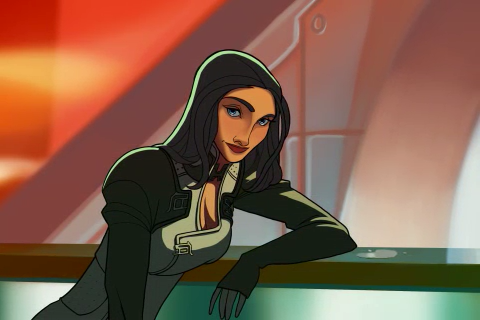 Mass Effect 2 [Bioware, 2010]'s Miranda Lawson, one of my example characters.
During Week 1 I borrowed M. Krawczyk & J. Novak's 'Game Story & Character Development" from the University library. I completed reading the book over the course of the week, and the source analysis report I wrote as a result can be found here.
"M. Krawczyk & J. Novak's 'Game Story & Character Development' is an important source for use with our project because its fifth, sixth and seventh chapters deal specifically with the traits our characters require to be believable. [...] This book has been a very useful source to study from both a theoretical and a practical standpoint. It has given rise to theoretical considerations such as to what extent a character is made from their design and their dialogue, and which traits are necessary and easy to replicate. From a practical standpoint it has enlightened us with regards to the danger of unsuited animations and voice acting, as well as providing a series of exercises that will help us create very well-rounded characters for use within our test."
I found this book especially useful, as I had not previously considered visual and auditory design of characters, only the personality traits they exhibited. This will make my forthcoming Character Study on Dragon Age [Bioware, 2009]'s Loghain Mac Tir deeper and more interesting.
Week II - Design Document Framework
The Title:
Creating interesting non-playable characters.
(Being a study into the contributing factors required to create interesting and believable characters within videogames.)
The Question:
What methods can we use to create realistic and engaging NPCs?
The Hypothesis:
If certain characteristics are considered more 'believable', then NPCs who have them will be more engaging to players.
Project Goals:
The ultimate goal of this project is to create some form of rule set for creating interesting Non Playable Characters (NPCs), and a clear explanation of the context these rules apply in. Through testing pre-defined characteristics that we theorise have positive or negative effects upon players, we should be able to create NPCs players consider 'realistic'. In order to reach this goal we will need to examine current thinking on the subject, case study games with interesting NPCs to look for common devices that we think make them interesting, and possibly distribute questionnaires/surveys to establish what type of person feels these characters are interesting, and how much they are in majority. Obviously it would be impossible to actually cover every possible device for making a character interesting and believable, so eventually it will be a requirement that we define the genre and subjects that will be tested (male 18-24).
The Test:
Our test will run a group of 'traditional videogamers' (males, 18-24) through a basic level and record their reaction to our NPC characters. We will gather qualitative and quantative data on their reactions through entry and exit questionnaires. To avoid an excessive number of personality variables, we must narrow down certain major traits. If we make characters too realistic (ie. totally multi-faceted) we will have far too many perspectives to test from. Our test framework must be such that variables can be changed without affecting the overall structure of the test. For example, making the character kind or callous- does the framework support this? By testing certain personality variables but leaving scope to modify them for repeat tests, we allow for the possibility of similar-conditions repeat testing.
Creating interesting non-playable characters.
(Being a study into the contributing factors required to create interesting and believable characters within videogames.)
The Question:
What methods can we use to create realistic and engaging NPCs?
The Hypothesis:
If certain characteristics are considered more 'believable', then NPCs who have them will be more engaging to players.
Project Goals:
The ultimate goal of this project is to create some form of rule set for creating interesting Non Playable Characters (NPCs), and a clear explanation of the context these rules apply in. Through testing pre-defined characteristics that we theorise have positive or negative effects upon players, we should be able to create NPCs players consider 'realistic'. In order to reach this goal we will need to examine current thinking on the subject, case study games with interesting NPCs to look for common devices that we think make them interesting, and possibly distribute questionnaires/surveys to establish what type of person feels these characters are interesting, and how much they are in majority. Obviously it would be impossible to actually cover every possible device for making a character interesting and believable, so eventually it will be a requirement that we define the genre and subjects that will be tested (male 18-24).
The Test:
Our test will run a group of 'traditional videogamers' (males, 18-24) through a basic level and record their reaction to our NPC characters. We will gather qualitative and quantative data on their reactions through entry and exit questionnaires. To avoid an excessive number of personality variables, we must narrow down certain major traits. If we make characters too realistic (ie. totally multi-faceted) we will have far too many perspectives to test from. Our test framework must be such that variables can be changed without affecting the overall structure of the test. For example, making the character kind or callous- does the framework support this? By testing certain personality variables but leaving scope to modify them for repeat tests, we allow for the possibility of similar-conditions repeat testing.
Sunday, February 14
Week II - Personal Goals
During Week 2 I have set myself a series of goals to achieve.
i. Finalise technical details such as our group hypothesis and how we will conduct our test.
ii. Read and evaluate M. Krawczyk's 'Game Story & Character Development" [2006].
iii. Continue to gather survey data as started in Week 1.
iv. Use survey data and developer commentary to write a character case study.
v. Begin the design document framework.
I estimate I will achieve at least half of these goals.
i. Finalise technical details such as our group hypothesis and how we will conduct our test.
ii. Read and evaluate M. Krawczyk's 'Game Story & Character Development" [2006].
iii. Continue to gather survey data as started in Week 1.
iv. Use survey data and developer commentary to write a character case study.
v. Begin the design document framework.
I estimate I will achieve at least half of these goals.

